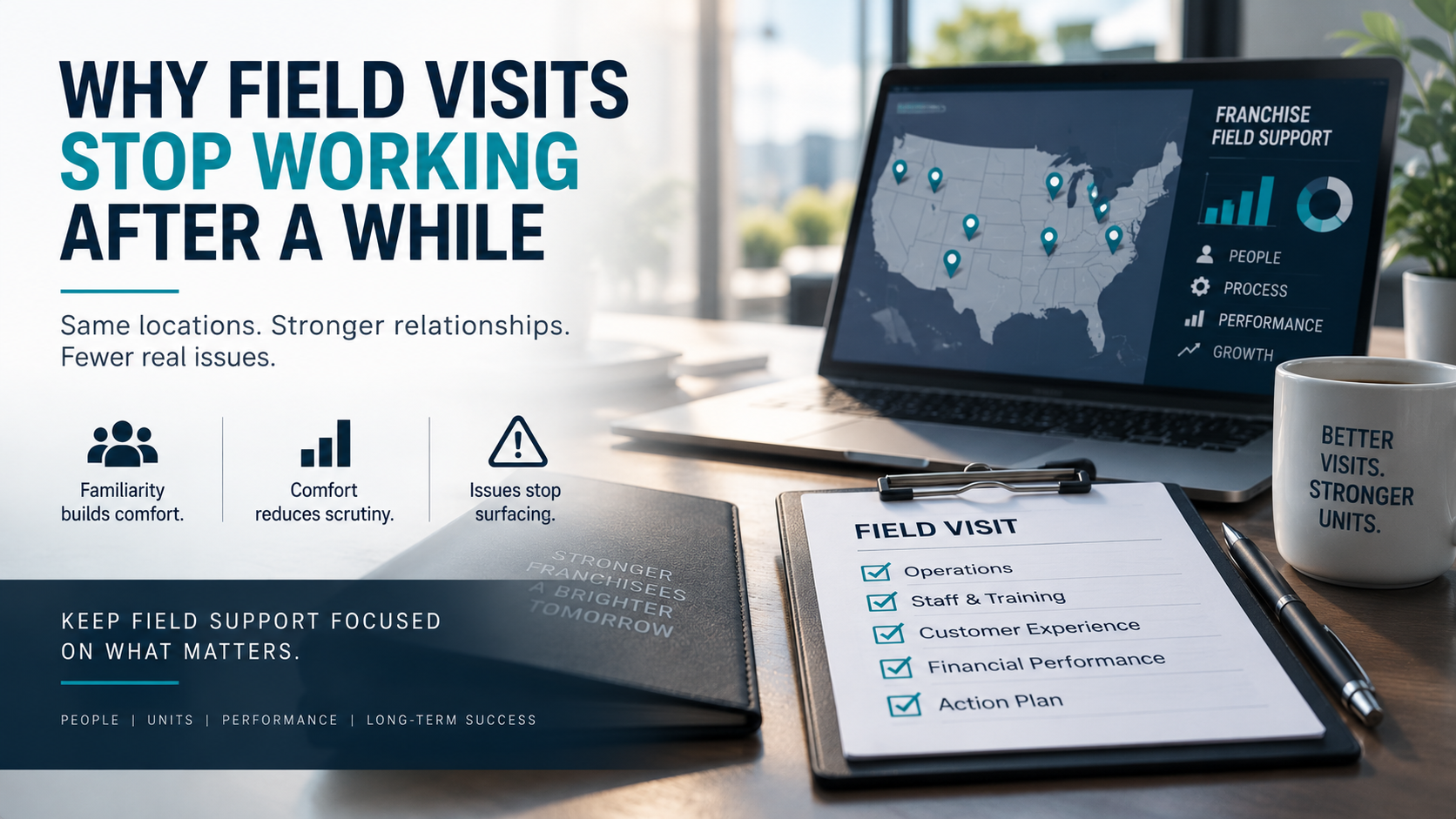
Why Field Visits Stop Working After a While
A field consultant has been visiting the same ten units for two years. Same franchisees, same locations, same friendly faces at the door. The visits have gotten shorter over that time. They’ve also gotten friendlier, and less useful, and nobody has noticed, because the calendar still shows the visit happened on schedule, every quarter, right on time.
The consultant would tell you the relationship with these franchisees is strong. That’s true, and it’s also part of the problem. Somewhere along the way, the visit stopped being an evaluation and became a check in between people who genuinely like each other. Real issues stopped surfacing, not because the units got better, but because nobody was looking as hard as they used to.
Familiarity Is the Quiet Enemy of Useful Field Support
Field support degrades in a specific, predictable way. It doesn’t fail loudly. It fades into relationship maintenance, one comfortable visit at a time, unless something in the structure keeps forcing it back toward genuine evaluation.
This happens because familiarity and rigor pull in opposite directions. The longer a consultant knows a franchisee, the more trust builds, and that trust is genuinely valuable. It also makes it harder to ask hard questions, because hard questions start to feel like accusations between people who’ve built a real relationship. A consultant who’s visited the same unit for two years starts noticing less, not because they’ve stopped caring, but because their eyes have adjusted to whatever’s normal there. Small drift becomes invisible precisely because it happened gradually, in front of someone who was there for every incremental step.
The franchisee experiences this the same way. Early visits feel like scrutiny, because everything is being evaluated by someone unfamiliar with the operation. Over time, visits start to feel like a friendly conversation with someone who already knows the business and already likes what they see. That shift feels good to both people in the room. It also means the visit stops doing the one thing it’s actually there to do, which is catch something nobody would have otherwise noticed.
Keeping Field Visits Honest
Rebuilding rigor into a field visit program doesn’t mean discarding the relationships that have been built. It means adding structure that keeps those relationships from replacing genuine evaluation.
Rotate who visits which units periodically. A fresh set of eyes catches things a familiar one has stopped seeing, simply because nothing looks normal to someone encountering it for the first time. This doesn’t mean rotating constantly, relationship continuity has real value too, but it does mean building in periodic rotation so no single consultant is the only person ever evaluating a given unit. This month, identify which units have had the same consultant for the longest stretch, and schedule at least one visit from someone different in the next quarter.
Structure visits around specific operational checks rather than open conversation. An unstructured visit naturally drifts toward whatever’s comfortable to discuss, which tends to be exactly the topics that already feel resolved. This week, build a short list of specific things every visit should check, regardless of how well the relationship is going, a handful of operational items that get verified every time, not just discussed if they happen to come up.
Separate relationship-building from performance evaluation. These are two different functions, and combining them into a single conversation lets the relationship quietly soften the evaluation. Consider structuring visits so a portion is explicitly evaluative, working through the specific checks, and a separate portion is relational, the conversation, the coaching, the catching up. This quarter, try clearly marking that shift out loud during your next few visits, so both the consultant and the franchisee know which mode they’re in.
The Field Visit Honesty Audit
Use these questions to test whether your field visits are still surfacing real issues, or just confirming what everyone already believes.
- When was the last time a field visit uncovered something genuinely surprising, rather than confirming what was already assumed.
- How long has your longest tenured consultant to unit relationship lasted, and when was the last time someone else evaluated that same unit.
- Do your visits follow a specific, repeatable checklist, or do they mostly unfold as open conversation shaped by whatever comes up naturally.
- Would your consultants describe their role during a visit as evaluating the business or catching up with a friend, and would they be honest with you about which one it actually feels like.
- If a brand new consultant visited your longest standing units tomorrow, do you think they’d notice something the current consultant has stopped seeing.
If most of these point toward comfort rather than scrutiny, your field visit program has likely drifted into relationship maintenance, even if the visits themselves are still happening exactly on schedule.
Rebuilding Rigor Without Losing the Relationship
None of this means treating longstanding relationships as a liability or starting over with a rotation of strangers. The goal isn’t less familiarity. It’s keeping familiarity from quietly replacing the evaluation the visit exists to provide.
Start with the units where the same consultant has been visiting the longest, since that’s where drift is statistically most likely to have set in unnoticed. Send someone different for one visit, not to replace the existing relationship permanently, but to get a genuinely fresh read on what that fresh perspective actually turns up. Whatever that visit surfaces will tell you a lot, either about that specific unit, or about how much your existing consultant has quietly stopped seeing over time.
From there, build the operational checklist into every visit going forward, regardless of how well any individual relationship is going. This isn’t about distrust. It’s about making sure the same specific things get verified every time, so no visit can drift entirely into conversation without at least confirming the operational basics first. Once that habit is in place, you’ll likely notice it changes the texture of the visits themselves, they become a little more purposeful, a little less purely social, without losing the warmth that makes franchisees actually want the consultant to show up.
Over time, this combination, periodic rotation and consistent structure, keeps your field support program doing what it’s actually there to do. It’s not about making visits less friendly. It’s about making sure friendliness never becomes a substitute for the honest evaluation that protects unit-level economics, catches problems while they’re still small, and keeps franchisee engagement built on real trust rather than comfortable routine.
Ready to find out whether your field visits are still catching what they should? Visit gersonadvisoryservices.com to talk through what a genuinely rigorous field support structure could look like for your system.