Every franchisor knows the number: fourteen days. It’s stamped into the FTC Franchise Rule, it shows up in every compliance training, and it gets treated like the whole story. It isn’t. Fourteen days is the legal floor under a candidate’s feet — not the runway they actually use before they sign.
I’ve spent fifty years on every side of this: as a franchisee, as a franchisor, and later as a supplier watching the pattern repeat across more than 1,500 systems during my years at FranConnect. The real story of what happens between FDD delivery and signature is more interesting, and more useful to franchisors, than the fourteen-day number lets on.
The Real Timeline
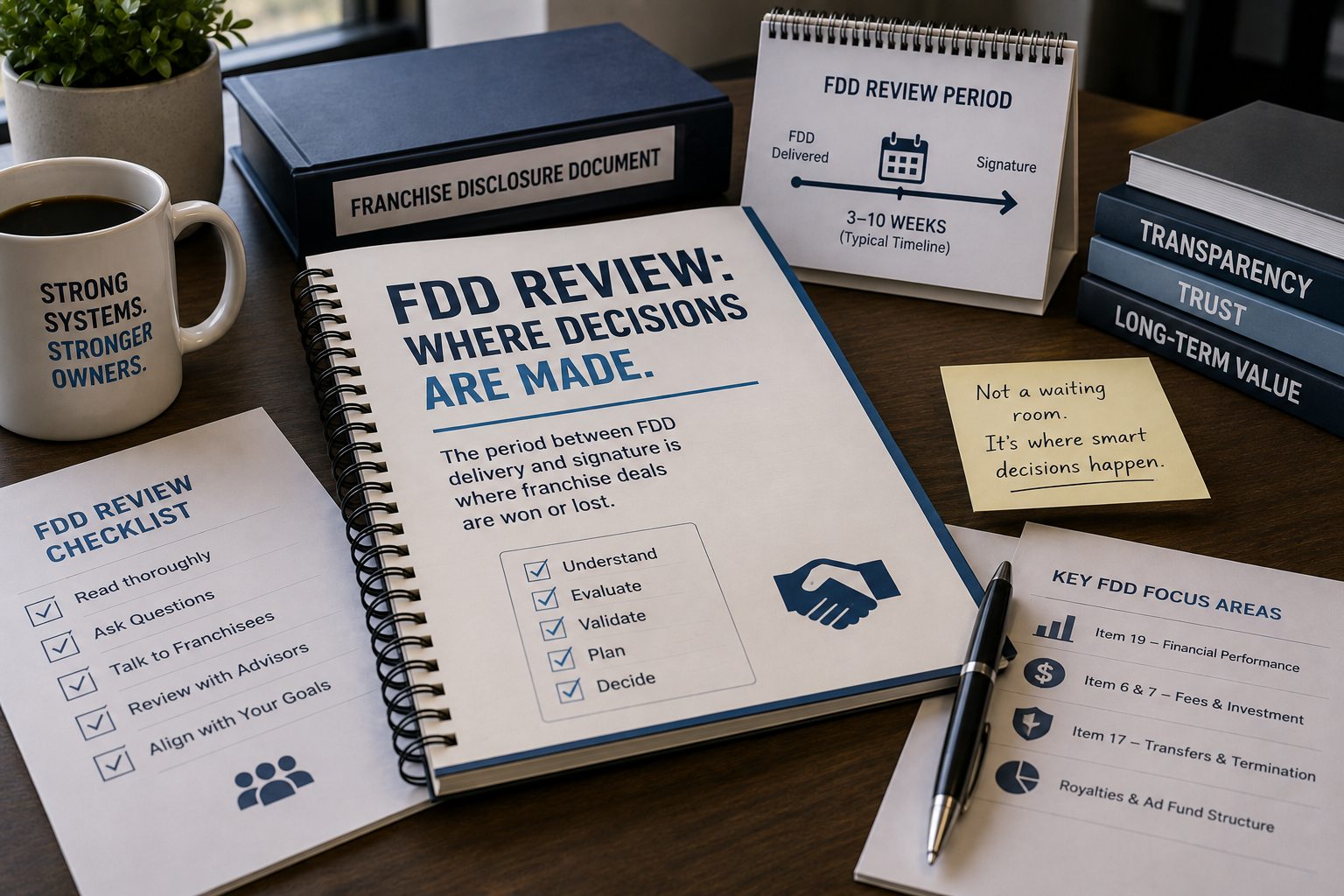
Almost nobody signs on day fifteen. In my experience, the real window runs closer to three to ten weeks from the day the FDD lands in someone’s hands. Some candidates stretch it three or four months — usually because financing is slow, a spouse needs convincing, or an SBA loan is crawling through underwriting.
I want to be straight about where these numbers come from, because I don’t like passing off a gut feel as data. Nobody publishes a clean study on “FDD receipt to signature” as its own metric. What is published is whole-funnel data. The 2026 Annual Franchise Development Report, from Franchise Update Media, puts the average lead-to-signature journey at 24 weeks now, and Discovery Day close rates at 75%, up from 65% the year before. Since the FDD usually goes out somewhere in the middle of that funnel, my best estimate is that the FDD-to-signature slice runs six to ten weeks for most brands. That’s a pattern read, not a citation. If your own CRM data says something different, trust it over mine.
Emerging vs. Mature: It’s Not What You Think
Does that distribution change between an emerging brand and a mature one? It does — just not the way most people guess. It’s not that mature brands close faster across the board.
Emerging brands see a wider spread. You get the founder-type buyer who signs fast because they believe in the story and want in early. And you get the buyer who stalls out, because there’s no bench of existing franchisees to call, thin Item 19 data if there’s any at all, and no fifteen-year track record to lean on. The document creates more anxiety per page when the brand is young.
Mature brands compress the fast end. The sales team has heard every objection a hundred times, there are dozens of franchisees to validate against, and the FDD reads as familiar instead of alarming. But mature brands stretch the slow end too, for one specific group: multi-unit buyers and private equity money. Those buyers bring lawyers and financial advisors into the review and negotiate development schedules and territory terms line by line. That population barely exists in emerging brands. It’s the group dragging out the mature-brand average.
Who Actually Fields “I Don’t Understand This”
Here’s a question I don’t think gets asked enough: who actually answers the phone when a candidate says, “I don’t understand this”?
On paper, that’s an attorney’s job. In practice, it’s the development rep, every time. That’s the relationship the candidate already has. Calling a lawyer feels like a much bigger step than replying to the person who’s been emailing them for six weeks.
That’s a real compliance risk, and it’s something I’ve flagged more than once in my sales mystery shopping work. Reps aren’t supposed to interpret legal terms or characterize what a franchisee might earn outside of Item 19. The well-trained ones answer the “where do I find this” questions and redirect anything substantive to “ask your attorney or your CPA.” The ones who aren’t trained just answer everything, and that’s exactly how FTC Rule problems get created.
There’s a second answer nobody talks about: existing franchisees on validation calls. They’re not supposed to give legal or financial advice either, but candidates trust them more than anyone else in the process. A lot of real translation of that document happens there — informally, off the franchisor’s compliance record.
What Buyers Actually Get Stuck On
After decades of reading these documents alongside candidates, I keep seeing the same four things.
Item 19 tops the list. Either it’s missing and the candidate doesn’t know what to do without it, or it’s there with a small sample size and they don’t know how to translate a range into their own market.
Items 6 and 7 come next — the fee schedule and the initial investment table. It’s not that anything’s hidden — there are just so many footnoted line items that it’s hard to build one real number in your head.
Item 17 is where I see the most regret after the fact. Termination, renewal, transfer — that’s where the non-compete and liquidated damages language lives, and candidates almost never work through it emotionally before they’re already invested in saying yes.
And royalty and ad fund structure trips people up constantly. What’s a flat fee, what’s a percentage, and what compounds — that distinction gets lost in the legal phrasing more often than it should.
Underneath all four, it’s the same root cause. It’s a 200-to-400-page document written for regulators, not for the person reading it at eleven at night trying to decide if this is right for their family. Most of what looks like buyer confusion is really just the format working against the reader.
What Franchisors Should Actually Do About It
Knowing the pattern is only half the job. Here’s what I’d tell any franchisor who wants to close that gap instead of just living with it.
Ask about their timeline instead of handing them one. Don’t quote candidates the fourteen-day minimum like it’s a deadline — and don’t hand them a number of your own instead. That answer belongs to the candidate, not to you. Ask who else is part of the decision — a spouse, a business partner, an investor — and what their own timeline looks like for being ready to move forward. Ask that early, and you’ll read a genuinely careful candidate correctly instead of writing them off as cold.
Track the FDD stage on its own. Most CRMs measure lead-to-close. Very few isolate what
happens between FDD delivery and signature. Start timestamping FDD delivery as its own pipeline stage. That’s the only way you’ll find out where your candidates are actually stalling.
There’s technology out now that takes this a lot further than a timestamp. It can tell you exactly how long a candidate spends inside the FDD, which sections they open, and how long they sit in each one. The better versions take that behavior and turn it into something your team can actually act on — a specific next step for that specific candidate, based on where they slowed down or where they’ve gone quiet.
I won’t turn this into a product pitch here — that’s not what this piece is for. But if you want to know what’s out there and which of it is worth your time, reach out to me directly and I’ll point you in the right direction.
If you’re an emerging brand, build a validation bench before you need one. You don’t have
fifteen years of franchisees to call, so create structure around the few you have — a rotating group willing to take calls, a written FAQ pulled from real candidate questions, and honest context around your Item 19 sample size instead of letting the small numbers speak for themselves.
If you’re a mature brand, build a separate lane for multi-unit and PE buyers. They move at a different pace and ask a different kind of question. Give them dedicated legal and development support so their negotiation doesn’t slow down your single-unit pipeline behind them.
Train your development team on the redirect, not just the pitch. Every rep should know
exactly which questions they can answer and which ones go straight to “talk to your attorney or your CPA.” Write it down. Practice it. This is the single highest-leverage compliance fix most franchisors haven’t made.
Get ahead of Item 17 early. Don’t let termination, renewal, and transfer language show up for the first time inside a 200-page document. Talk about it plainly in the discovery conversation, before the candidate is emotionally invested in a yes. It builds trust instead of spending it.
Give candidates a plain-language companion, not a shortcut. A one-page walk-through of the fee schedule or the royalty structure can help enormously — as long as it’s reviewed by counsel and never conflicts with what’s actually in the FDD. The goal is clarity, not a workaround.
None of this shortens the fourteen-day floor, and it shouldn’t. The floor exists to protect the candidate, and that protection is the whole point of the process. What these steps do is make the weeks after day fourteen work better for everyone — franchisor and candidate both.
Franchisees first. Growth follows. That’s exactly why this stage of the process deserves more attention than it gets.