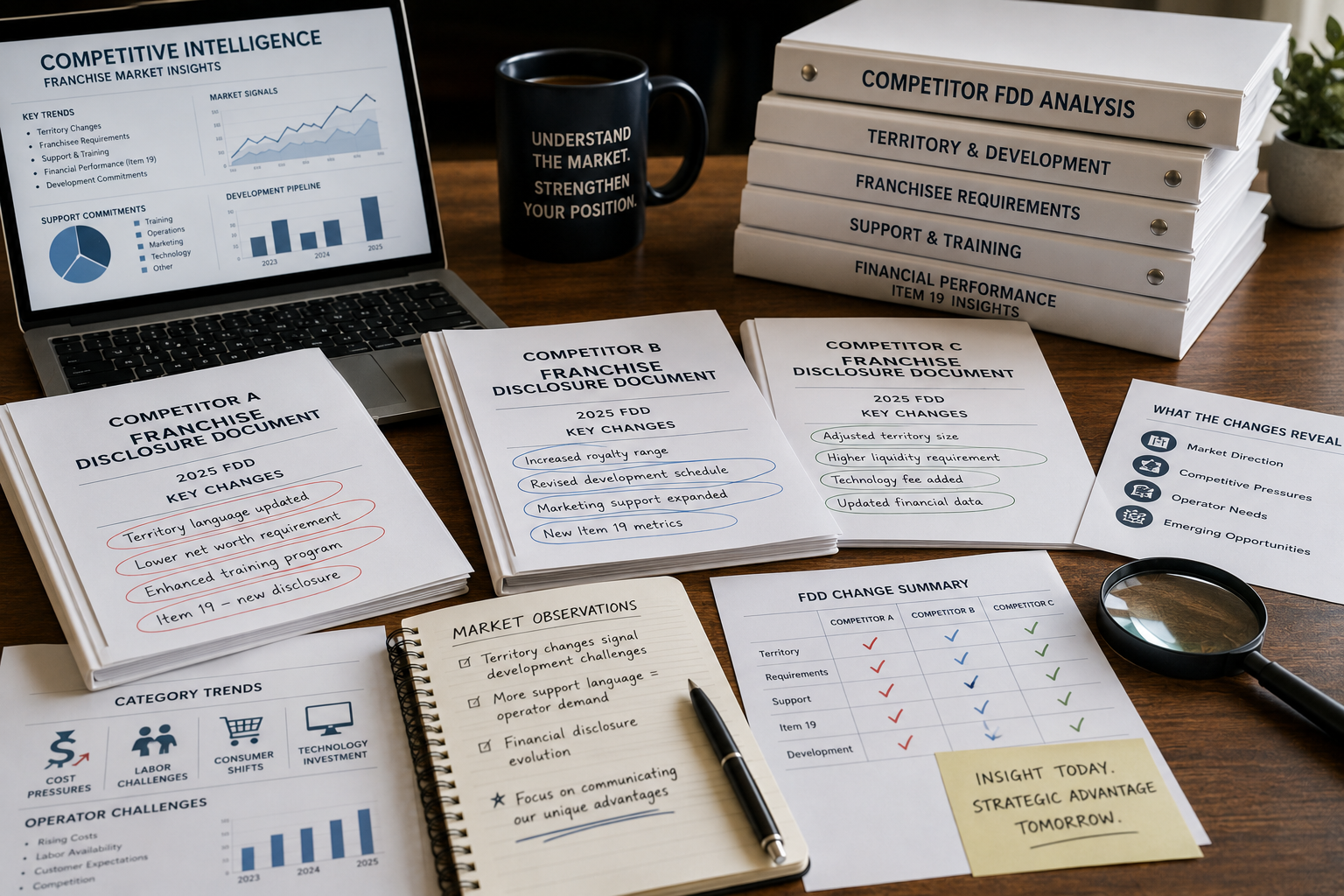
As we move into another FDD season, I’ve been thinking about one of the most overlooked sources of competitive intelligence in franchising.
Most franchisors spend considerable time reviewing their own FDD each year. Far fewer spend time reviewing what has changed in their competitors’ documents.
To me, that’s often where the real insight lives.
When a franchisor changes territory language, adjusts franchisee requirements, modifies support commitments, or updates its Item 19, those changes are usually a response to something. It may be franchisee feedback, development challenges, operational realities, competitive pressure, or simply lessons learned from the field.
The document itself is interesting. The changes are often more interesting.
Over time, those changes create a roadmap of how brands are adapting to the market, where they may be struggling, and where they believe competitive advantages can be created.
The strongest franchisors I’ve worked with don’t obsess over competitors. But they do pay attention to the signals the market is sending. Understanding those signals often leads to better decisions, stronger positioning, and a more compelling story for prospective franchisees.
One of the misconceptions in franchise development is that candidates are comparing franchise brands.
In reality, they’re often comparing risk.
Every candidate is trying to answer a similar question: Which opportunity gives me the greatest confidence in my ability to succeed?
That confidence is shaped by many factors, including economics, leadership, training, support, validation, and brand positioning. It is also influenced by how competing opportunities are presented during the evaluation process.
This is one reason I believe competitive intelligence is so valuable. Not because franchisors should imitate competitors, but because they should understand the context in which candidates are making decisions.
A brand can have an outstanding opportunity and still lose candidates if it doesn’t fully understand how it is being compared in the marketplace.
Schedule a 30-Minute Competitive Intelligence Consultation
The most effective franchise development organizations understand both sides of the conversation. They know their own story exceptionally well, and they understand where competing brands are strong, where they are vulnerable, and how prospects are likely to evaluate the differences.
I have always believed there is a difference between watching competitors and studying the market.
Watching competitors tends to create reactive behavior. Studying the market creates better decision-making.
Every year, franchisors leave clues behind in their FDDs. New disclosures appear. Certain language disappears. Support programs evolve. Financial representations change. Development strategies are refined.
Most of these changes are responses to something happening inside the business or in the broader market.
Viewed individually, the changes may seem insignificant. Viewed collectively, they often tell a story about where a category is heading, what challenges operators are facing, and how brands are adapting.
For franchisors preparing for 2026, this may be one of the most valuable exercises they undertake. Not because competitors have all the answers, but because understanding how the market is evolving provides important context for the decisions your own organization will make.
Sometimes the best insights don’t come from looking inward. They come from paying attention to what everyone else is learning.