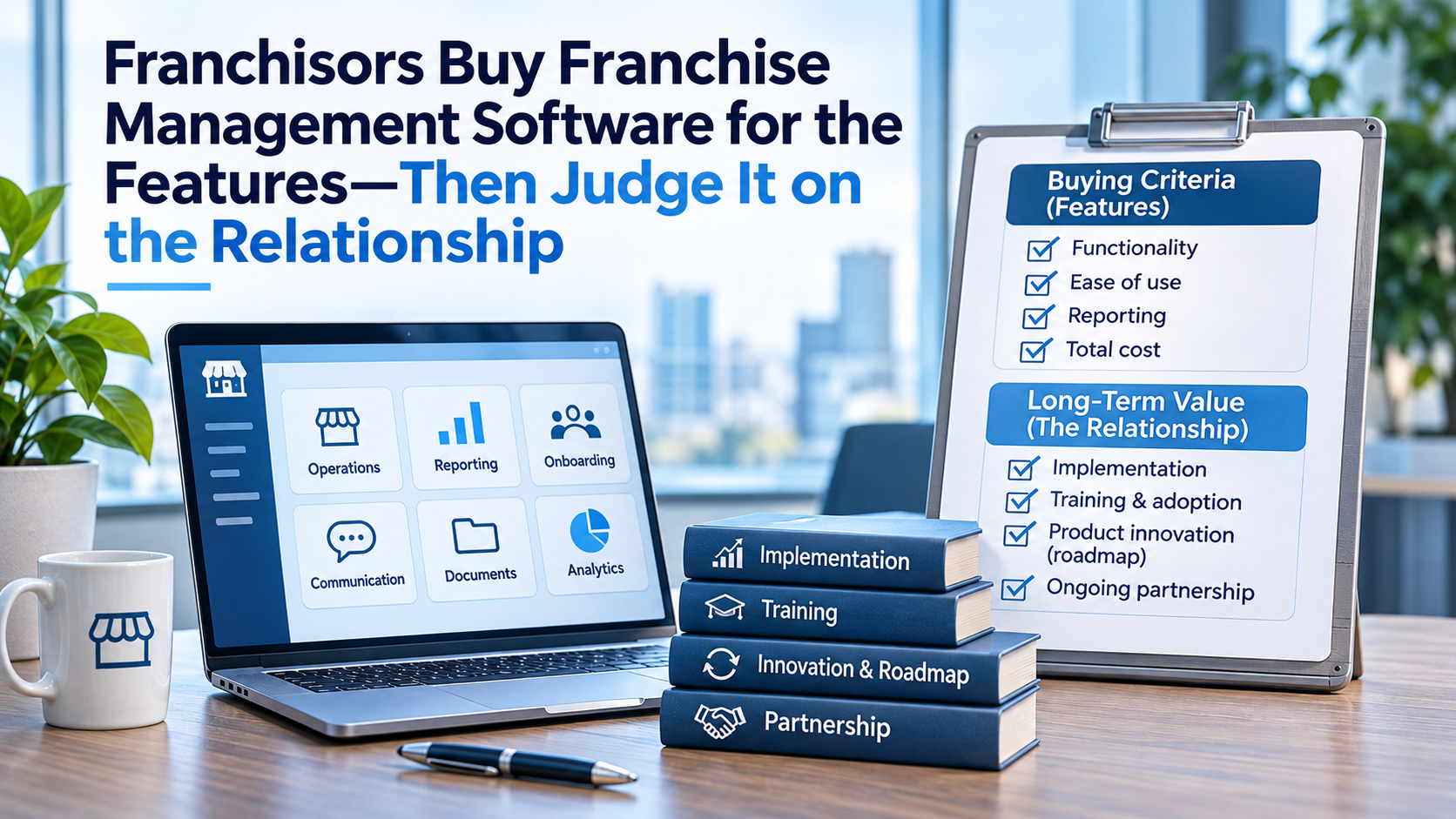
I’ve participated in more franchise software evaluations than I can count, and most of them begin the same way: with a feature checklist.
Does the platform provide the functionality we need? Is it easy to use? How strong is the reporting? What will it cost? Can it replace any of the other systems we are already paying for?
These are reasonable questions. But they may not be the questions that determine whether a franchise brand will still value the platform three or five years later.
Our 2026 Voice of the Franchisor Compass™ study uncovered a significant disconnect between how franchisors select franchise management software and how they ultimately judge its value.
When respondents identified their top purchase considerations, product functionality ranked first, followed by ease of use, customer support, reporting and total cost of ownership.
Here’s the number that stopped me: only 4% placed product innovation and roadmap among their top three buying priorities. Implementation services were selected by 4%. Training resources were selected by just 2%.
Yet after the platform was purchased and implemented, those overlooked factors became closely connected to whether the organization believed it was receiving meaningful value.
The feature checklist only tells part of the story
Features are easy to compare.
A selection team can create a spreadsheet, schedule demonstrations and check boxes while each vendor presents its capabilities. It can compare prices, dashboards, workflows, mobile access and reporting tools.
What is harder to evaluate is what happens after the contract is signed.
How effectively will the vendor guide implementation? How well will it train headquarters employees and franchisees? Will it continue improving the platform? Will it listen when the brand’s needs change? Can the account team operate as a strategic partner, or will the relationship become a series of support tickets?
In my experience, this is where franchisors often get it wrong. They spend months evaluating what the software does today and far less time evaluating the company they will depend on tomorrow.
The study found that product innovation was the largest relative driver of perceived value. Customer support and strategic partnership were the leading drivers of whether respondents would recommend their provider.
Franchisors may buy a platform based on what it does today, but they judge it based on how well the technology and the relationship develop over time.
Franchise brands do not remain static
A franchise brand’s technology needs change as the system grows.
An emerging brand may initially need franchisee onboarding, document management and basic communication. As the organization expands, it may need stronger integrations, more sophisticated reporting, unit-level benchmarking, workflow automation and predictive insights.
The platform that appeared to meet every requirement during the original demonstration may begin to feel limited if the vendor’s roadmap does not keep pace.
That does not necessarily mean the original selection was wrong. It may mean the evaluation placed too much emphasis on current functionality and too little on the vendor’s ability to evolve.
Franchise management software is not a one-time purchase. It becomes part of the brand’s operating infrastructure.
Franchisors are making a decision about the technology, the implementation team, the customer-success organization and the vendor’s future direction. And yet, most evaluation teams spend far more time reviewing features than investigating any of those things.
Rewrite the evaluation scorecard
Franchise leaders should continue evaluating functionality, usability, reporting and cost. Those factors matter.
But they should not dominate the selection process to the point that implementation, training, innovation and partnership become afterthoughts.
Before selecting or renewing franchise management software, leadership teams should ask:
- What has the vendor delivered during the last 24 months?
- How does it support adoption after implementation?
- What ongoing training is available for employees and franchisees?
- Can the platform evolve as our franchise system grows?
- Can we speak with customers who have used it for several years?
Those answers will tell you more about your future with the vendor than another polished demonstration ever will.
References are especially important. Do not speak only with a newly launched customer who is still enthusiastic about implementation. Speak with customers who have lived with the platform long enough to experience support issues, product changes, leadership turnover and evolving business requirements.
Ask them whether the vendor still feels like a partner.
The relationship is part of the product
Franchise management software rarely succeeds because of technology alone.
It succeeds when the platform is usable, implementation is thoughtful, training continues, the roadmap remains relevant and the vendor helps the brand increase adoption over time.
Franchisors should stop treating the vendor relationship as something that begins after the software decision. The relationship is part of the decision.
A vendor may win the initial evaluation with the longest feature list or the lowest price. But if the platform stops evolving, adoption remains low and the relationship becomes reactive, those initial advantages will mean very little.
Here’s where I land: features may get a vendor into the final presentation, but the relationship determines whether the investment keeps creating value.
You are not simply selecting software. You are choosing the company your franchise brand may depend on for years.
Evaluate that relationship with the same discipline you apply to the technology.
This article is based on findings from the 2026 Voice of the Franchisor Compass™ Franchise Management Software Benchmark Study by Gerson Advisory Services.